Why Trivandrum’s Airport-to-Technopark Corridor Is Emerging as One of India’s Smartest Tech Addresses
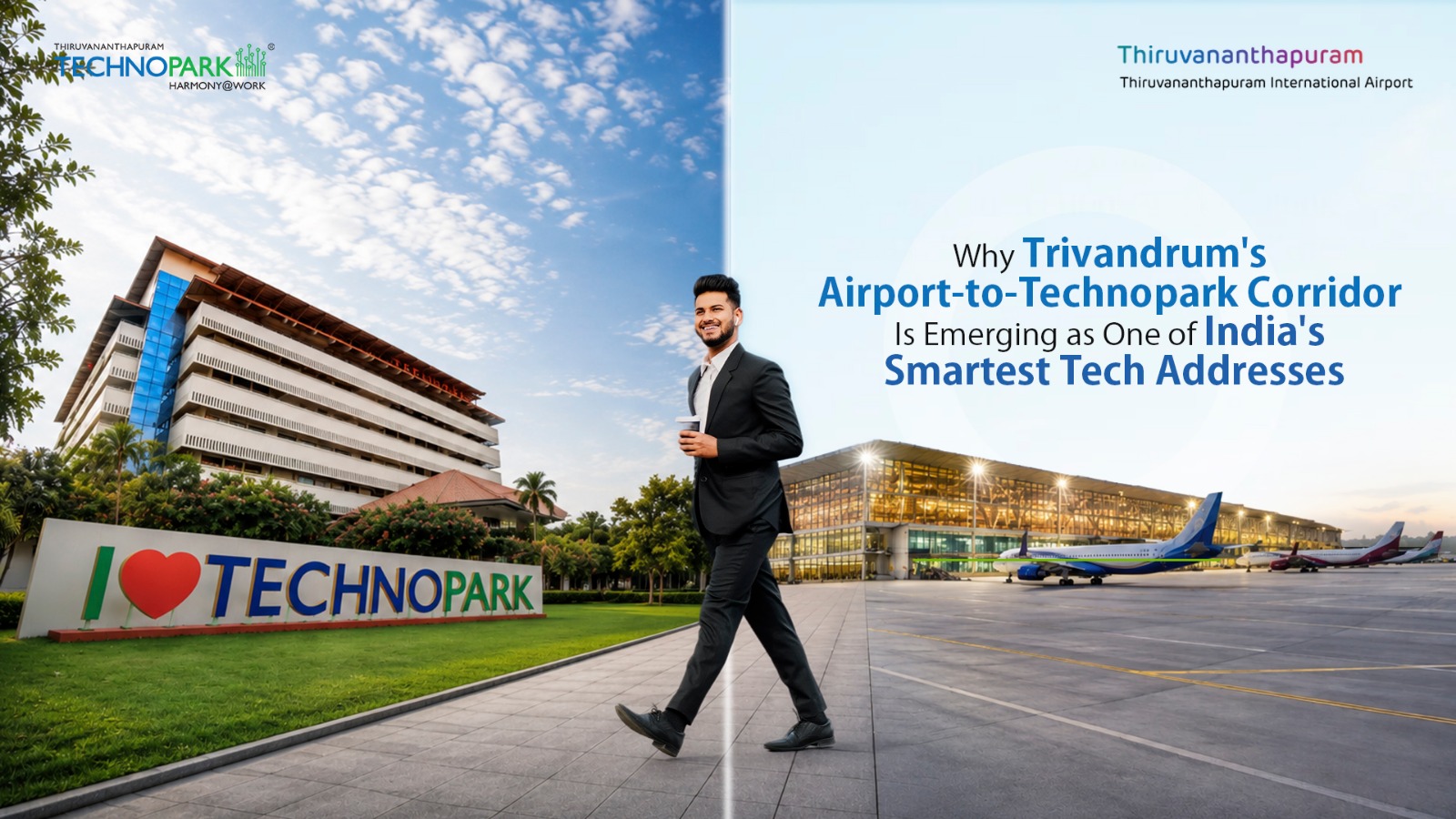
In many of India’s established technology centres, the journey from airport to office is an accepted inefficiency a function of scale, congestion, and urban sprawl that companies have learned to work around.
Thiruvananthapuram is one of the few Indian technology destinations where that friction is remarkably low. Trivandrum International Airport sits roughly fifteen to twenty minutes from Technopark, depending on the campus and time of day. For a city that is home to India’s first IT park and an increasingly visible GCC destination, this is not a minor convenience. It is one of the city’s most understated structural advantages — and it is becoming more valuable as the ecosystem scales.
The Compression of Distance
Technopark today is among Asia’s largest and greenest IT park ecosystems, with hundreds of companies and tens of thousands of professionals working across its campuses. The corridor between the airport and Technopark benefits from relatively direct highway connectivity without the kind of prolonged urban congestion common in larger metros.
For a CXO arriving from Frankfurt or Singapore, this means landing and reaching a meeting room before many larger cities have fully exited airport traffic. For GCC leadership teams operating from Trivandrum, it means frequent travel without the productivity drain that often comes with long airport commutes.
That compression of distance has business consequences. It affects how often global headquarters visit. It changes the ease with which leadership teams engage with local operations. It improves perception during location evaluations where operational efficiency matters as much as cost. For companies building or expanding GCCs, these seemingly small efficiencies compound over time.
Project Anantha and the Next Phase of Airport Growth
The airport itself is now entering a new phase of expansion. Under Project Anantha, the Adani-led redevelopment of Trivandrum International Airport is expected to significantly enhance passenger handling capacity and modernize the airport’s overall infrastructure. The project includes a new terminal, expanded international facilities, upgraded cargo infrastructure, additional check-in capacity, an airport hotel, and a redesigned architectural identity inspired by Kerala’s traditional forms.
The significance is not merely the construction itself, but what it signals.The city is preparing infrastructure designed for the scale and connectivity expectations of a Tier-1 technology ecosystem while retaining the operational advantages of a lower-congestion urban environment.
Connectivity as an Integrated System
Air connectivity is only one part of the story. Trivandrum already maintains direct international links to the Gulf, Southeast Asia, and South Asia, alongside strong domestic connectivity to major Indian metros. International access continues to improve through expanding airline partnerships and codeshare networks.
Simultaneously, the surrounding infrastructure grid is being reshaped. The upcoming Outer Ring Road is expected to become a major development spine connecting Technocity (Phase IV), the airport, Vizhinjam Port, and the city’s emerging growth corridors. Alongside this, the coastal highway network, the western economic corridor extending toward Kanyakumari, Vande Bharat rail connectivity, and future mass-transit proposals are gradually redefining regional mobility.
Vizhinjam adds another strategic layer that remains underappreciated outside Kerala. India’s first deepwater transshipment port is now operational just a short drive from both the airport and Technopark corridor. For technology companies with interests in logistics, hardware systems, advanced manufacturing support, maritime technology, or supply-chain operations, the proximity of a global port and international airport within the same compact geography is unusual in the Indian context.
What Exists at the Other End of the Corridor
Connectivity matters only if there is a strong ecosystem at the other end. Trivandrum’s advantages here are increasingly visible: a highly educated workforce, strong engineering and science institutions, a steady talent pipeline, and quality-of-life indicators that consistently rank Kerala among India’s stronger human development environments.
The economics further strengthen the proposition. Grade-A office rentals, operational expenditure, and talent costs remain meaningfully lower than those in other Metro/ Tier 1 Cities, while infrastructure quality continues to improve. The less visible advantages — lower attrition, longer employee tenure, reduced commute fatigue, and stronger work-life balance — are increasingly relevant for GCC operators managing long-term scaling.
What Technology Companies Are Actually Buying
Companies choosing Trivandrum today are not simply optimizing for lower rentals.They are buying into an increasingly integrated operating environment: a short airport-to-office commute, expanding international connectivity, proximity to a major deepwater port, a mature IT park ecosystem, significant co-developer and infrastructure investment, an emerging technology township around digital science, space, defence, AI, and deep-tech ecosystems, and a state policy environment that is increasingly aligned toward GCC and technology-led growth.
As GCC models evolve, as hybrid work reduces the importance of traditional urban centrality, and as executive travel becomes more frequent but shorter in duration, infrastructure efficiency itself becomes a competitive advantage. That is where Trivandrum’s airport-to-Technopark corridor stands out.
For more than three decades, the city has quietly built an ecosystem around connectivity, talent, livability, and institutional stability. With airport expansion now underway, Vizhinjam operational, and large-scale regional infrastructure projects gathering momentum, that advantage is becoming harder to ignore.
For companies evaluating the next decade of technology growth in India, the value proposition is increasingly clear: shorter commutes, deeper talent pools, lower operating costs, stronger connectivity, and a city whose infrastructure still has room to scale gracefully.