

India’s IT investment map has long been dominated by the same handful of cities. When companies talked about setting up technology centres or Global Capability Centres (GCCs), Bengaluru, Hyderabad, Chennai, Pune and Mumbai were the default answers. That reputation was well earned.
But rising real estate costs, saturated talent markets and the operational complexity of running large teams in crowded metros have pushed companies to look beyond the obvious. When they do, many find that Thiruvananthapuram, Kerala’s capital city, has a more compelling case than they expected.
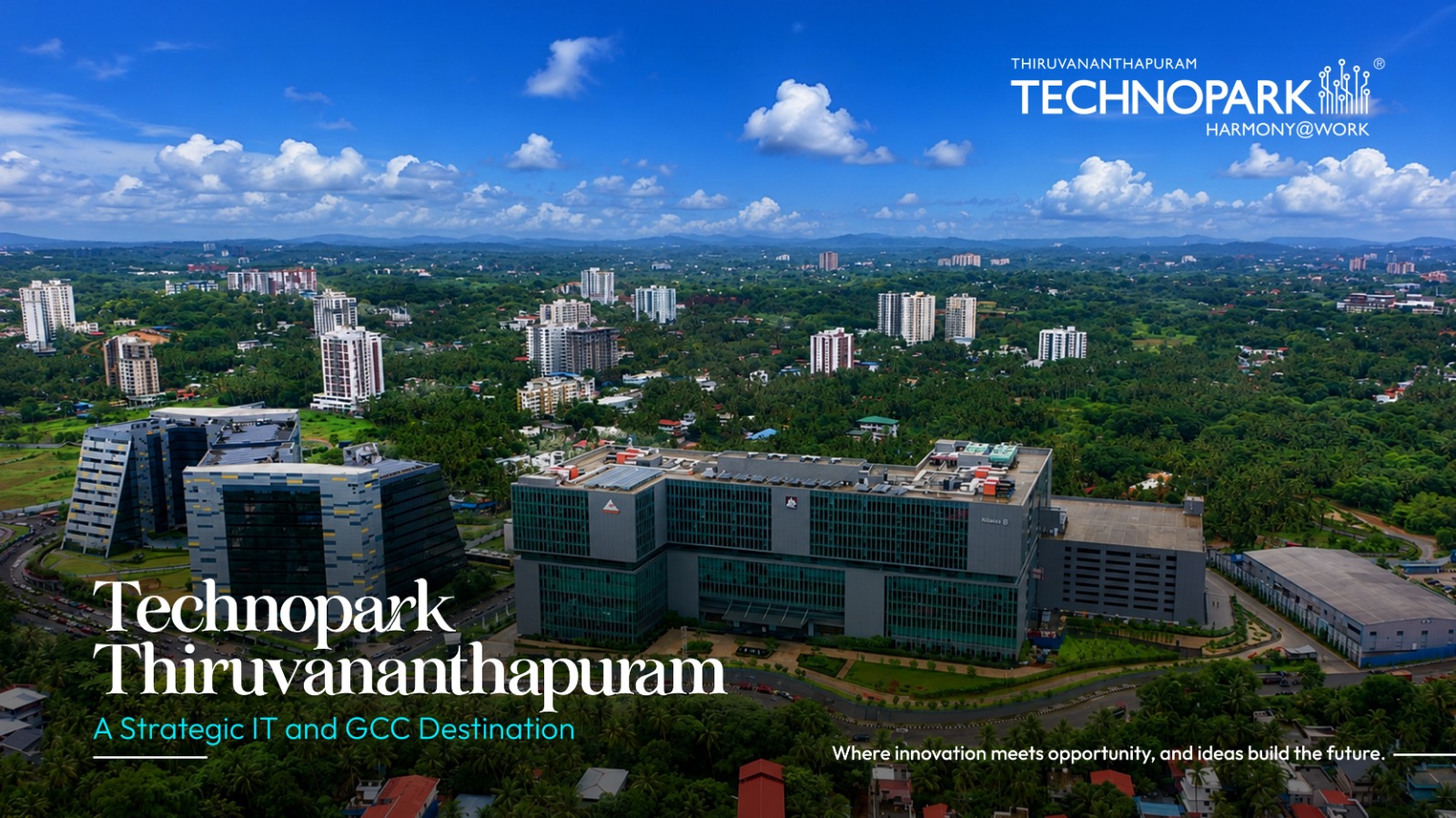
At the heart of that case is Technopark. Founded in 1990, it is India’s first IT park and now one of Asia’s largest, spanning 768 acres with 13.147 million square feet of state-of-the-art workspace . It houses over 540 technology companies, including more than 20 GCCs, and directly employs around 84,000 professionals, with a further 2,25,000 in indirect employment. Technopark alone accounts for 55% of Kerala’s software export revenue, which stood at Rs 14,575 Crores in FY 2024–25.
This is not a city that is just starting out. Thiruvananthapuram has been building its technology credentials for over three decades.
What Makes Thiruvananthapuram Worth a Closer Look?
When companies assess a new location, the decision rarely comes down to one factor. They look at talent availability, operating costs, infrastructure quality, connectivity and long-term growth potential. Technopark holds up well across all of these.
Lower Costs, Without the Trade-offs
Cost is a practical starting point for any location decision. Thiruvananthapuram offers meaningfully lower operating costs than Tier-1 cities. The city’s cost of living runs roughly 25% below that of metros, with a Consumer Price Index of 207 and a Governance Index of 380. Office rents and operational costs are considerably more competitive. What companies get in return is not a step down in quality. Technopark’s campus includes SEZ and non-SEZ facilities, plug-and-play workspaces and a 25 MVA power distribution system with built-in redundancy.
Infrastructure Built for Global Operations
Technopark was purpose-built for technology companies, and that shows in how it functions. The campus provides redundant high-speed fibre connectivity from multiple telecom providers. It holds ISO 9001, ISO 14001 and ISO 45001 certifications. It is also one of India’s greenest IT parks, with IGBC-certified buildings, sewage treatment facilities and a sustainable campus design.
Beyond Technopark itself, Thiruvananthapuram has a sizeable pipeline of infrastructure investment. A Rs 5,581 Crore metro rail project covering 21.8 km is under development. The Rs 1,300 Crore Terminal 2 expansion at Trivandrum International Airport, designed for 12 million passengers annually, is under construction. The 625-km Kerala Coastal Highway is progressing, with completion targeted for 2026. These are not proposals; they are projects with funding and timelines.
A Reliable Talent Supply
Talent availability is where many Tier-2 cities fall short. Thiruvananthapuram is different. Kerala is among India’s leading states for employable talent (India Skills Report 2025), one of the top states in terms of ease of doing business (BRAP) and has a literacy rate of 96.2%. The city itself has a literacy rate of 95.1% and produces approximately 20,000 graduates annually.
The city is home to institutions that rank nationally. IIST is Asia’s first space university. IISER Thiruvananthapuram, CET, IIITM-K, and Digital University Kerala (DUK) are among the city's leading institutions, with three of its institutes featuring in the Top 50 of the NIRF Rankings. Together, these institutions strengthen Thiruvananthapuram's reputation as a centre for higher education, research, and innovation. The city is ranked third for employable talent and fourth as a preferred city to work in India.
Workforce stability is another factor that matters when building a GCC, which depends on institutional knowledge and long-term team depth. The city’s workforce participation rate stands at 37.3%, and the turnover rates that are common in larger metros are much less of a problem here. Organisations like the Kerala Startup Mission and ICT Academy support ongoing talent development. The Kerala Startup Mission currently supports over 1,080 tech-enabled startups.
An Established Company Community
One factor that does not get enough attention is the breadth of Thiruvananthapuram’s existing technology community. More than 540 companies operate here across a wide range of technology domains. The list includes Infosys, TCS, HCLTech, Accenture, Tata Elxsi, Oracle, UST, Nissan Digital, Quest Global, dSPACE, H&R Block, IBS Software, SunTec, Armada and Equifax. The GCC presence includes EY, Allianz Services,Arch Global Services, ICON, Safran, Guidehouse and Envestnet, among others. Allianz Services has been in Trivandrum since 2003 and has grown into one of the major GCCs in the state.
For a company setting up a new centre, that kind of community matters. It means a talent pool already trained in enterprise technology, established vendor ecosystems and peer companies that have solved many of the same operational problems you will face.
Connectivity That Works for International Operations
Trivandrum International Airport currently serves 23 international routes across 11 countries, with strong connections to the Middle East, Southeast Asia and beyond. The airport is undergoing redevelopment/expansion under Project Anantha, with capacity set to reach 12 million passengers per year. For companies coordinating with international clients or managing global teams, these are practical connections.
By road, the city connects via National Highway 66, part of Kerala’s IT Corridor. Rail connectivity is supported by major stations such as Thiruvananthapuram Central and Thiruvananthapuram North, with Kazhakkuttom serving the Technopark side of the city. A proposed Silver Line high-speed rail corridor would cut travel time from Thiruvananthapuram to Kasaragod to under four hours.
Vizhinjam: A Port That Changes the Equation
The Vizhinjam International Seaport, now operational in Phase 1 following a Rs 7,525 Crore investment, is India’s first mega transshipment port. It sits just 10 nautical miles from the international shipping route, giving it a natural deep-draft advantage that no other Indian port has. Phase 2, expected to cost Rs 13,000 Crore, will bring capacity to 5 million TEUs by 2028, with direct connectivity to global maritime routes.
For IT and GCC investors, the day-to-day operational impact may be limited at first. The broader effect on the city is more significant. Better logistics, growing international trade links and the confidence signal that comes with this scale of infrastructure investment all factor into a long-term location decision.
Investment Opportunities at Technopark
For sizeable expansion, companies have two main options within Technopark:
Technopark Phase III covers 90.02 acres between Phases I and II, adjacent to the Thiruvananthapuram Bypass Road in Attipra Village. It sits within Technopark’s existing campus, with all infrastructure already in place. Companies such as Allianz Services operate from Phase III buildings including the Ganga and Yamuna towers. Of the 90.02 total acres, 10 acres (approx) of land is currently available for development. The nearest railway station, Kazhakuttom, is 4 km away.
Technopark Phase IV (Technocity) is Technopark’s largest expansion to date. Spread across 389.74 acres, roughly 5 km from the main campus near Pallippuram and Mangalapuram, Technocity is designed as a self-contained district. At full build-out, it could accommodate 2,00,000 professionals, with over 4 million square feet of new space currently under development and an estimated 30,000 jobs in the near term. Of the total land, 121.6 acres is currently available. Phase IV is also home to the Rs 250 Crore Emerging Technology Hub, covering Space Tech, Healthcare and Med Tech, Agri Tech and Life Sciences, Energy and Renewables, AVGC and XR. The Kerala Defence Innovation Zone (K-DIZ) forms part of this cluster.
Major upcoming projects in the city include a 1.5 million square foot World Trade Centre by Brigade Group in Technopark Phase I, a 6 million square foot Embassy Taurus Downtown project in Technopark Phase III and a 4 million square foot QUAD project in Technopark Phase IV.
Why the Timing Makes Sense
Large enterprises have increasingly moved towards distributing their operations across multiple cities rather than concentrating everything in one or two locations. What they look for is a place that offers quality at a competitive cost, a stable workforce, infrastructure that can support global operations and a business environment without unnecessary friction.
Thiruvananthapuram fits that profile. Kerala ranks among top states in terms of ease of doing business. Thiruvananthapuram was the first Indian city to win the UN-Habitat Global Award for Sustainable Development in Cities. It has a 96% literacy rate and some of the country’s best educational institutions. It is home to ISRO’s Vikram Sarabhai Space Centre, India’s first space technology hub. And it has 35 years of experience running India’s first IT park.
For decision-makers evaluating where to build their next engineering centre, establish a GCC or scale their technology capabilities, Technopark Thiruvananthapuram deserves to be on the shortlist.
Source
-
Colliers India, City Profiling Thiruvananthapuram, Report - Sept 2025
-
ANSR Research, Emerging Cities: India's Next Frontier for GCC Expansion (2026)
-
Technopark. Official Website. Available at: https://technopark.in/