Bringing Global Experience Home: Thiruvananthapuram’s Opportunity to Attract Returning Talent
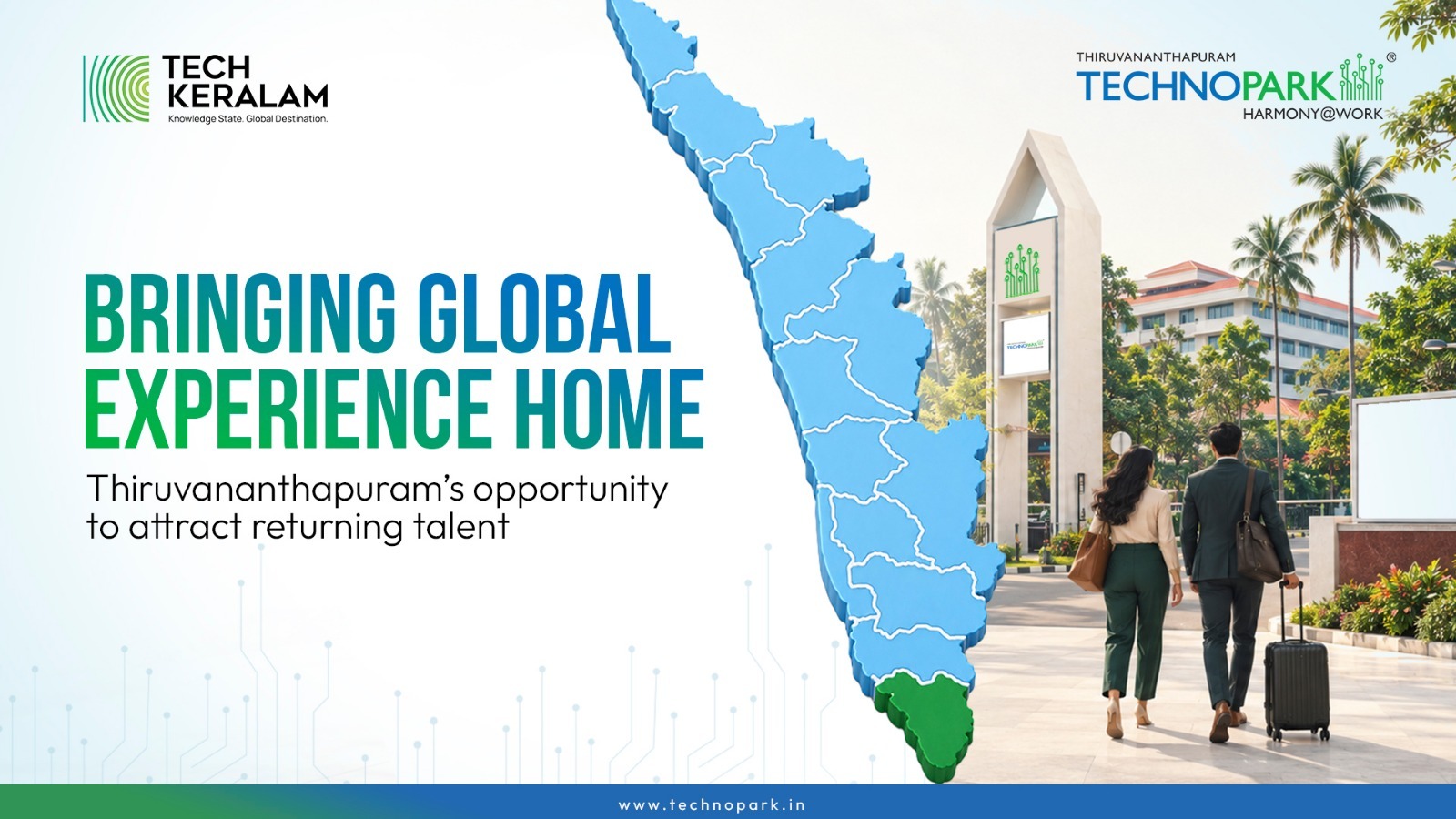
For professionals considering a return to Keralam, the decision involves both personal aspirations and professional expectations. Proximity to family may be an important consideration, but a sustainable return also depends on suitable employment, opportunities for advancement and an environment that supports continued learning.
Thiruvananthapuram has an established foundation from which to address these expectations. Through Technopark, its academic institutions and its developing innovation infrastructure, the capital region offers several pathways for professionals seeking to apply experience gained elsewhere.
The opportunity is to connect that experience with Keralam’s next phase of technology-led development. Returning professionals can contribute as employees, entrepreneurs, mentors, researchers and business leaders. Creating the conditions for these contributions requires coordinated attention to employment, enterprise development, infrastructure and skills.
Understanding the Opportunity for Talent to Return
The expression “reverse brain drain” describes the return of skilled people to their place of origin after studying or working elsewhere. In the context of Thiruvananthapuram, it is useful to approach this as an opportunity that can be strengthened through practical measures.
An established technology ecosystem can make returning a more viable professional choice. However, the presence of companies, infrastructure and support programmes alone does not establish that a large-scale reversal of migration has occurred. Such a conclusion would require specific evidence on professional migration and employment outcomes.
The immediate focus should therefore be on the conditions that help people return successfully: relevant roles, credible employers, opportunities to build enterprises and access to professional networks. These conditions also benefit people who have chosen to establish their careers within Keralam.
Technopark Provides an Established Employment Foundation
A return to Keralam becomes easier to evaluate when professionals can assess an existing industry base. Technopark provides that foundation in Thiruvananthapuram.
Established by the Government of Keralam in 1990, Technopark’s official website reports more than 540 enterprises and technology companies, employing over 84,000 professionals. Its infrastructure extends across approximately 768 acres, with more than 13.14 million square feet of developed IT space. This scale gives returning professionals an established ecosystem to explore.
For an experienced professional, the relevance of this ecosystem extends beyond the number of employers. A relocation decision may depend on whether the available roles match a particular specialisation, level of responsibility or long-term career objective.
Technopark also maintains an official jobs portal through which professionals can review vacancies advertised by companies. This provides a practical starting point for understanding current requirements and identifying opportunities that correspond with individual experience. Applications should follow the instructions provided in the relevant vacancy listing.
Thirike Connects the Return Aspiration with Opportunity
Kerala Startup Mission’s Thirike initiative directly addresses the interest among Malayali technology professionals in returning to Keralam. Its official platform describes a mission to connect professionals across the world with opportunities that can support their return and help address talent demand and supply in the state’s technology sector.
This approach recognises a practical challenge: employers and professionals need ways to identify one another. A company considering expansion needs to understand the availability of suitable talent. A professional considering relocation needs visibility into roles that match their capabilities.
Initiatives that improve these connections can support more informed decisions on both sides. Their value depends on the relevance of the opportunities and the quality of the resulting engagement.
For Thiruvananthapuram, an established technology employment centre, this wider state-level effort is relevant to the continuing development of its talent ecosystem. It provides an additional avenue through which professionals can explore a return while assessing their individual career requirements.
Returning Experience Can Support More Specialised Work
Professionals who have worked across different markets may bring experience in managing complex projects, serving international clients, developing products or leading multidisciplinary teams. When matched with suitable roles, these capabilities can contribute to the development of local enterprises.
For example, a professional with experience in enterprise software may help a company strengthen product delivery. Someone with experience in international business development may support entry into additional markets. An engineering leader may contribute to team development, technical processes and project execution.
These are potential contributions rather than measured outcomes of return migration. They illustrate why attracting experienced talent can be relevant to an ecosystem seeking to expand its capabilities.
Technopark identifies Global Capability Centres, research and development, engineering and digital transformation among the activities supported by its business environment. These areas provide a relevant context for considering how specialised professional experience could contribute to future enterprise growth.
Entrepreneurship Offers Another Pathway Home
For some professionals, returning to Keralam may involve establishing a business. Experience gained in other markets can help a founder recognise customer requirements, identify operational problems and assess opportunities for new products or services.
Kerala Startup Mission provides an institutional framework that prospective founders can explore. Its official information describes support through pre-incubation, incubation, acceleration and mentorship. These mechanisms are intended to assist startups at different stages of development.
For a returning entrepreneur, structured support can help turn an initial idea into a more clearly defined venture. Relevant tasks may include validating the customer problem, developing a business model, identifying technical requirements and preparing for market entry.
Participation and assistance depend on the conditions of the applicable programme. The broader significance is the availability of an organised startup support system through which founders can seek guidance and explore suitable opportunities.
Workspace Options Can Support Different Business Stages
Returning entrepreneurs and professionals establishing local teams may have different infrastructure requirements. A small venture may need a ready-to-use workspace, while a larger organisation may require a customised office or a dedicated facility.
Technopark describes several accommodation models, including furnished coworking facilities, warm-shell offices, custom-built spaces and land-lease arrangements. Its startup guidance also explains options through which enterprises can develop workspace suited to their operational requirements.
This range is relevant because business requirements change over time. A founder may initially prioritise flexibility and a manageable setup process. As the organisation grows, its requirements may expand to include dedicated facilities, additional teams or specialised infrastructure.
Access to different workspace models can support that progression. Enterprises considering a facility should assess current availability, applicable terms and the suitability of the space for their proposed activities.
Advanced Learning Can Strengthen Career Continuity
Returning professionals may also wish to deepen their knowledge, move into a new specialisation or participate in research. Access to advanced education can therefore form part of the wider proposition for talent retention and return.
Digital University Kerala, located at Technopark Phase IV, focuses on postgraduate and doctoral education, research and innovation in digital technologies. Its official academic information identifies areas including artificial intelligence, data science, cybersecurity, electronics, geoinformatics, sustainability and digital transformation.
The presence of such an institution creates scope for professionals and enterprises to explore academic engagement, applied learning and research connections through the university’s available programmes and institutional arrangements.
For a technology ecosystem, continuing education has a wider role. It helps connect professional experience with emerging knowledge and supports the development of capabilities required by changing industries.
Technocity Adds a Longer-Term Development Perspective
An ecosystem seeking to attract talent must also consider its capacity for future growth. Technocity, Technopark Phase IV, forms an important part of that development perspective.
Technopark’s published master plan brings together technology infrastructure, research areas, education and skill development, commercial facilities and social amenities. Existing anchors include Digital University Kerala, the Kabani IT Building and the SunTec building. The plan also identifies further development associated with emerging technologies and innovation.
These components should be understood according to their respective stages of development. The master plan sets out a framework for implementation over time.
For professionals considering a long-term future in the region, this planning approach is relevant because employment decisions interact with housing, mobility and everyday services. Coordinating these requirements can help support a more practical environment for enterprises and their workforce.
Building Sustainable Connections with Returning Talent
Attracting professionals is one part of the task. Enabling them to build fulfilling careers and contribute over time requires sustained attention.
Employers have a role in providing clear responsibilities, appropriate career pathways and opportunities to apply specialist knowledge. Academic and innovation institutions can support learning and collaboration. Experienced professionals can contribute through mentoring, entrepreneurship and the development of teams.
These relationships can also benefit early-career talent. Knowledge gained in international or national markets can be shared through structured workplace learning, professional engagement and collaboration with emerging enterprises.
Thiruvananthapuram has several foundations for advancing this opportunity: an established technology industry, startup support mechanisms, advanced digital education and infrastructure planned for further development. Connecting these strengths with the aspirations of professionals considering a return can help expand the region’s capabilities.
The objective is to make returning to Keralam a professionally sustainable choice; one through which global experience can support local enterprise, create opportunities for others and contribute to the state’s knowledge economy.
Sources
-
Technopark — Official website
https://technopark.in/ -
Technopark — Job Vacancies
https://technopark.in/job-search -
Kerala Startup Mission — Thirike
https://thirike.startupmission.in/ -
Kerala Startup Mission — Frequently Asked Questions
https://startupmission.kerala.gov.in/faq -
Technopark — Workspace and Business Setup Guidance
https://technopark.in/start-here -
Technopark — Workspace Options
https://technopark.org/ -
Digital University Kerala — About DUK
https://www.duk.ac.in/admission/about/ -
Technopark — Technocity Master Plan
Technocity Masterplan Unfolds