

Thiruvananthapuram has spent more than three decades building an investment ecosystem that few cities outside India’s traditional metropolitan centres can match. While the city is widely recognised for its technology sector, its economic strengths now extend far beyond IT services.
Kerala’s capital is home to India’s first IT park, some of the country’s most important space and defence institutions, leading centres for medical and scientific research, a strong network of higher-education institutions, and the Vizhinjam International Seaport, India’s first deepwater container transshipment port.
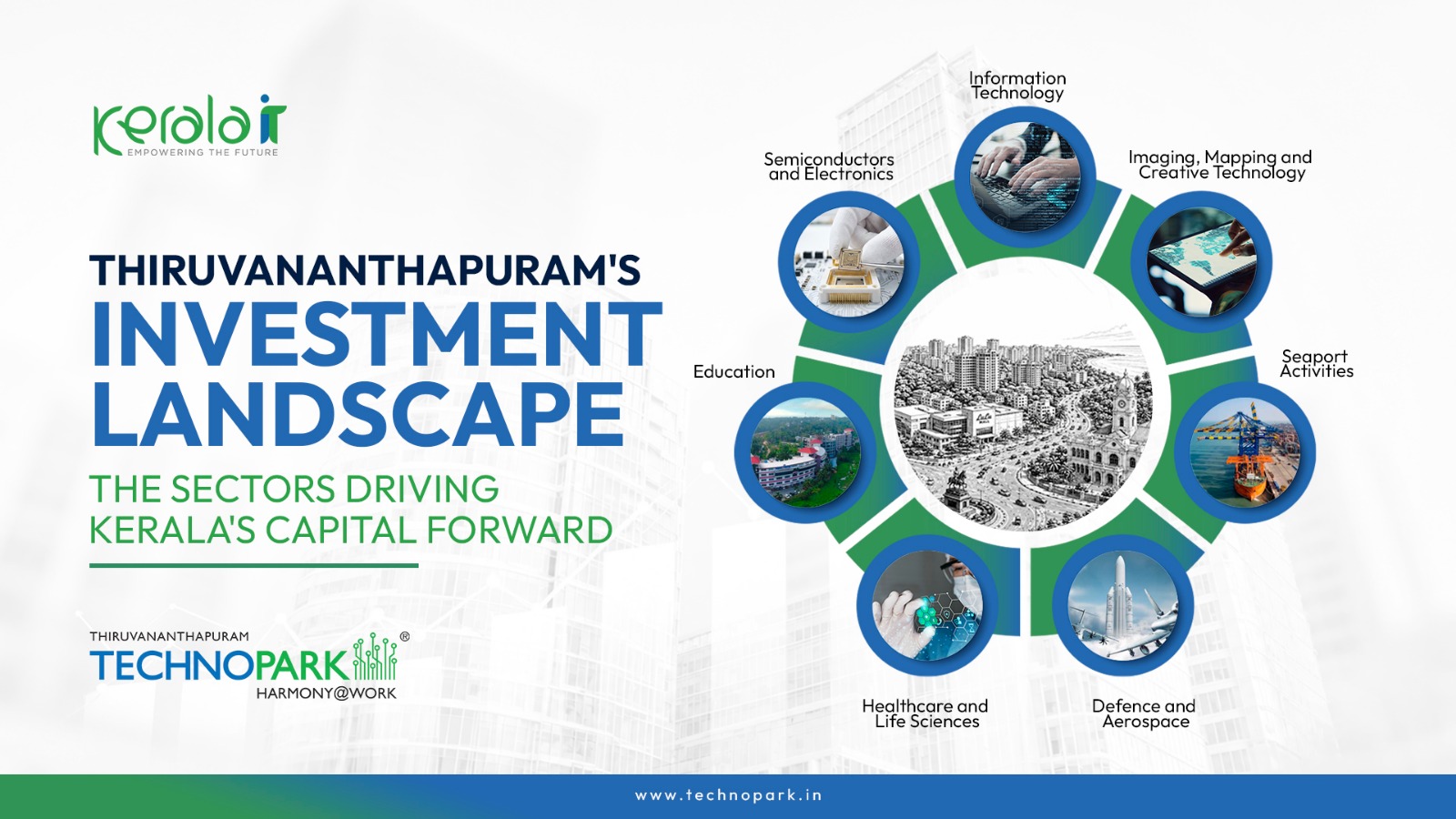
Together, these assets are creating a diversified economy supported by skilled talent, research capabilities, modern infrastructure and strong institutional networks. According to Colliers India’s City Profiling Thiruvananthapuram report, seven sectors are central to the city’s investment landscape: Information Technology, Semiconductors and Electronics, Education, Healthcare, Defence and Aerospace, Seaport Activities, and Imaging and Mapping. Each sector has its own growth drivers. However, their real strength lies in how they connect- and Technopark Thiruvananthapuram is an important part of that connection.
Information Technology: The Foundation of the City’s Growth
Information Technology remains the anchor of Thiruvananthapuram’s economy. The city’s long-standing contribution to Kerala’s technology sector, expanding workforce and growing base of specialised companies have earned it the reputation of being the “Silicon Valley of Kerala.” Technopark Thiruvananthapuram lies at the heart of this story. Established in July 1990 and dedicated to the nation in November 1995, Technopark is India’s first IT park. Its journey began in 1994 with two companies, 155 employees and 1.07 lakh sq. ft. of built-up space.
Today, Technopark spans 768.63 acres across its campuses and offers 13.147 M Sq. ft of builtup space. It is home to 540+ companies and more than 84,000 professionals. Its growth from a pioneering IT park into a large technology ecosystem reflects both the evolution of Kerala’s digital economy and the confidence that businesses continue to place in Thiruvananthapuram. The park’s export performance reinforces this momentum. IT exports increased from ₹13,255 crore in FY 2023–24 to ₹14,575 crore in FY 2024–25. Global and national companies such as Accenture, Infosys, TCS, EY and UST operate from Technopark, alongside firms working in automotive technology and next-generation services.
This diverse mix shows that Thiruvananthapuram’s technology sector is no longer limited to conventional software development. It is steadily moving towards specialised digital services, research-led businesses and technology-enabled sectoral clusters.
Semiconductors and Electronics: An Emerging Opportunity
Semiconductors and Electronics is among the city’s most promising emerging sectors. Thiruvananthapuram combines an established electronics base with a skilled technical workforce, research institutions and government-supported initiatives.
The presence of organisations such as KELTRON provides an institutional foundation, while Technopark’s campuses are increasingly supporting enterprises working in hardware, electronics and deep technology. This combination of industry experience and technical talent gives the city the potential to contribute to India’s wider ambitions in electronics design, semiconductor technology and advanced manufacturing.
Education: Powering the Talent Pipeline
Education supports every major investment sector in Thiruvananthapuram. The city has a strong concentration of universities, engineering colleges and scientific institutions, including the University of Kerala, the Indian Institute of Space Science and Technology, the Indian Institute of Science Education and Research, Digital University Kerala and the College of Engineering Trivandrum.
These institutions create a steady pipeline of graduates, engineers, researchers and technology professionals. Their presence also makes collaboration between academia, industry and government more practical.
For Technopark and the companies operating within it, this academic network is a major advantage. Access to local talent supports recruitment, specialised training, research partnerships and long-term workforce development. It also helps the city attract businesses that require more than a general technology workforce, including companies in aerospace, electronics, medical technology, data science and advanced engineering.
Healthcare and Life Sciences: From Care to Research
Thiruvananthapuram’s healthcare ecosystem is supported by Kerala’s established public-health framework and a strong base of medical and scientific institutions.
The Sree Chitra Tirunal Institute for Medical Sciences and Technology, the Genome Data Center and the Rajiv Gandhi Centre for Biotechnology contribute to the city’s capabilities in medical research, biotechnology, genomics and healthcare innovation. The Bio Life Sciences Park, identified as India’s first integrated life-sciences park, further strengthens the sector’s potential.
Together, these institutions create opportunities across biotechnology, medical technology, diagnostics, clinical research and healthcare services. Medtech companies within Technopark’s wider ecosystem also create opportunities for collaboration between healthcare specialists and technology teams.
This relationship between research and digital capability is particularly important as healthcare becomes increasingly dependent on data, software, imaging and technology-enabled delivery.
Defence and Aerospace: A Strategic Ecosystem
Thiruvananthapuram occupies an important place in India’s space, defence and aerospace landscape. The city is home to the Vikram Sarabhai Space Centre, BrahMos Aerospace, the Indian Institute of Space Science and Technology and the Liquid Propulsion Systems Centre at Valiamala.
Kerala Space Park and the Kerala Defence Innovation Zone add a startup- and innovation-focused layer to this established institutional base. The city also hosts the Southern Air Command at Akkulam, the Pangode Military Station and a Border Security Force Sector Headquarters. India’s proposed Maritime Theatre Command is also expected to add to Thiruvananthapuram’s strategic importance. This concentration creates opportunities in aerospace engineering, defence technology, propulsion systems, advanced materials and associated digital services. Technopark has an important enabling role here as well. Its incubation legacy is closely connected with Kerala Startup Mission, which is the state’s nodal agency for the startup ecosystem and is also driving the Kerala Defence Innovation Zone.
Seaport Activities: Opening a New Economic Corridor
The Vizhinjam International Seaport has added a major new dimension to Thiruvananthapuram’s investment landscape. As India’s first deepwater container transshipment port, Vizhinjam offers deepwater capabilities and strategic access to major international shipping routes. Its development has the potential to strengthen India’s maritime trade while creating new opportunities across the wider Thiruvananthapuram region. As port operations grow, demand is expected to increase in warehousing, logistics, transportation, supply-chain management and supporting infrastructure.
The port’s impact can extend into the digital economy as well. Modern logistics depends on software, data platforms, mapping, communications and technology-enabled operations. Thiruvananthapuram’s existing IT base—and Technopark’s concentration of technology companies—can support the digital requirements of this emerging port-led ecosystem.
Imaging, Mapping and Creative Technology
Imaging and Mapping brings together a broad range of activities, including medical imaging, geospatial technologies, urban mapping and the growing Animation, Visual Effects, Gaming and Comics segment.
Institutions such as the Centre for Development of Imaging Technology and the International Centre for Free and Open Source Software provide a foundation for this emerging cluster. The city’s technology workforce and research capabilities further support applications in healthcare, urban planning, animation, gaming and digital content. This is another area where Thiruvananthapuram’s sectors intersect. Medical imaging connects with healthcare, geospatial technology supports urban planning and logistics, and animation and gaming draw on the same digital talent base that supports the wider IT industry.
Technopark as the Connecting Platform
Although Information Technology remains Technopark’s core strength, the park’s influence extends across much of the city’s investment ecosystem. Companies operating from its campuses are active in fintech, medtech, edtech, automotive technology and next-generation digital services. Data centres and other forms of digital infrastructure also align with the city’s connectivity, power availability and supportive policy environment.
Technopark’s contribution goes beyond physical infrastructure. Its Technology Business Incubation Cell, launched in 2006, was later expanded into Kerala Startup Mission. This helped create an institutional bridge between established enterprises, emerging startups, academia and government-led innovation programmes.
Organisations including IIST, ICFOSS, KSITM and KSITIL either operate within Technopark’s broader institutional ecosystem or maintain close working links with it. These connections help ideas, talent and technical expertise move between sectors. Location is another important advantage. Technopark offers access to Thiruvananthapuram International Airport, Thiruvananthapuram Central railway station, National Highway 66 and Vizhinjam International Seaport. For businesses, this creates practical connections to the city’s technology, research, defence, healthcare and logistics networks. Technopark’s ISO 9001:2015, ISO 14001:2015 and ISO 45001:2018 certifications also demonstrate its focus on quality management, environmental responsibility, and occupational health and safety. Combined with its scale and green campus environment, these strengths reinforce its role as a leading destination for technology-led investment.
A Diversified Future Built on Proven Strengths
Thiruvananthapuram is no longer defined by a single industry. IT continues to provide a strong economic foundation, but semiconductors, healthcare research, aerospace engineering, port-linked logistics, and imaging and creative technology are all gaining relevance. These sectors are connected by common advantages: skilled talent, respected institutions, research capability, physical and digital infrastructure, and a supportive technology ecosystem.
Technopark remains central to this transformation. It represents the city’s proven ability to build at scale while also providing the infrastructure and networks needed by emerging industries. For organisations evaluating their next location in India, Thiruvananthapuram offers a compelling combination—an established technology base, expanding sectoral opportunities and an ecosystem designed for long-term growth.
Sources
-
Colliers India, City Profiling Thiruvananthapuram Report – Sept 2025
-
Technopark Thiruvananthapuram official website, technopark.in—homepage and “Why Technopark” page.
-
Kerala IT / Kerala State IT Mission official website, keralait.org.